
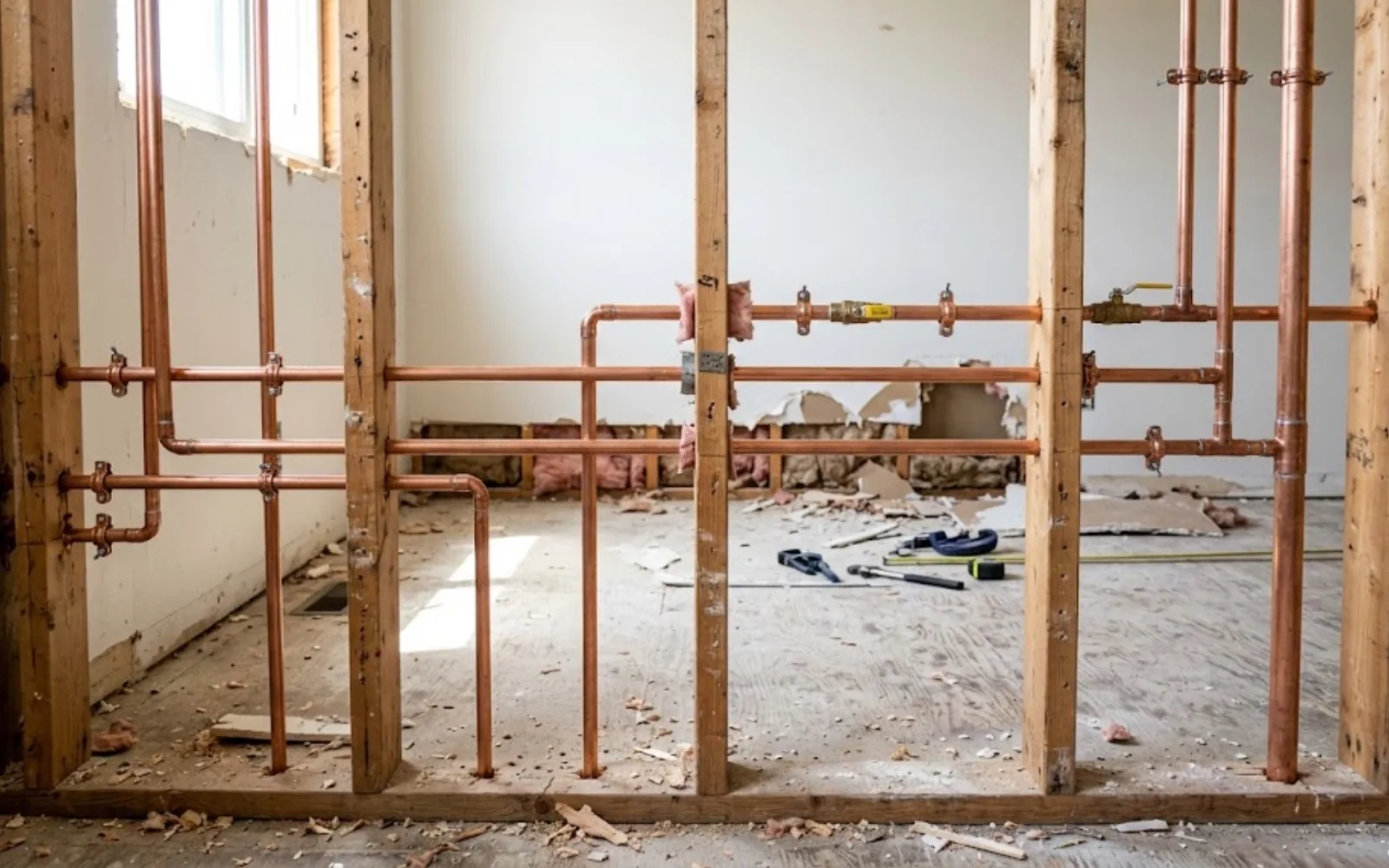
Repeated Leaks or Bad Water Pressure? Here's What It Might Mean
If you've called a plumber for a leak two or three times in the past year, in different rooms or fixtures, that pattern points to systemic pipe failure rather than bad luck. Galvanized steel supply lines, common in homes built before the 1960s, corrode from the inside over decades, narrowing the pipe and eventually failing at random points along its length.
Discolored water when you first turn on a tap, especially after the water's been sitting overnight, is another common sign, since it usually means rust is flaking off the interior of an aging galvanized line. A full repipe replaces the supply lines throughout the home with copper or PEX, both of which resist the internal corrosion that causes this pattern in older pipe.
Signs Your Home May Need a Repipe
Recurring Leaks in Different Locations
Multiple unrelated leaks over a short period usually mean the pipe material itself is failing, not a single bad section.
Rusty Water at First Use
Discolored water when a tap hasn't been used for a while is a classic sign of internal corrosion in galvanized pipe.
Low Water Pressure Throughout the House
Corrosion narrowing the inside diameter of old pipes restricts flow everywhere, not just at one fixture.
Home Built Before the 1960s
Original galvanized steel plumbing in a home this age is approaching or past its expected service life.
Repiping Older Homes in Carson
Carson has neighborhoods with housing stock going back to the city's early development, and homes from that era were commonly plumbed with galvanized steel supply lines. Galvanized pipe has a functional lifespan of roughly 40 to 60 years before internal corrosion becomes a serious problem, which puts a meaningful share of Carson's older housing stock at or past that point.
A whole-home repipe is a significant project, but it's usually less disruptive than most homeowners expect. We typically work room by room, cutting minimal access points in drywall, and coordinate the work to keep water shut off for the shortest time possible. Copper and PEX are both code-compliant options in California. We'll walk through the tradeoffs, copper's proven longevity versus PEX's lower cost and faster installation, based on your specific home.
Because repiping touches nearly every fixture in the home, it's also a natural point to address other issues, like replacing old shutoff valves that may no longer seal properly, at the same time rather than as a separate future project.
Whole-home repiping questions come up most in Carson's older residential streets, including the tracts around Carriage Crest Park and Dominguez Park. If your home there still has its original galvanized lines, a pipe assessment shows whether a repipe makes more sense than another round of patching.
Our Repiping Process
Assess the Existing System
We confirm the pipe material and map out the full supply line layout before quoting.
Choose Copper or PEX
A recommendation based on your home's layout and budget, with the tradeoffs explained clearly.
Room-by-Room Installation
Minimal drywall access points, sequenced to keep water off for the shortest time possible.
Pressure Test and Patch
Every new line pressure-tested before we close up access points.
Why Choose Us for a Repipe
Experience With Older Carson Homes
Familiar with the galvanized steel plumbing common in this city's older housing stock.
Copper and PEX Both Offered
An honest comparison based on your home, not a one-size-fits-all recommendation.
Minimal Disruption
Work sequenced to limit both drywall access and time without water.
Free Estimates
A full home assessment and written estimate before you commit to the project.
Galvanized Supply Lines and What Replacement Involves
Homes with galvanized steel supply lines often show rusty or brownish water, falling pressure and leaks at threaded joints. Replacement removes the corroded steel and runs new copper or PEX in its place.
We walk the house with you, explain how many fixtures each line feeds and give a price before work starts. Many owners ask about a partial repipe first, and we will say honestly when only part of the system needs to go.
What Affects the Price of Repiping & Whole-Home Pipe Replacement
We can't give an accurate number without seeing the job, but these are the real factors that move the price up or down.
Copper vs. PEX
Copper costs more upfront with a longer track record. PEX costs less and installs faster with a strong warranty history.
Number of bathrooms and fixtures
A repipe scales with how many fixtures the new lines need to reach throughout the home.
Drywall access required
Homes with more finished walls need more patching after the new lines are run.
Home's overall square footage
A larger home simply has more linear feet of pipe to replace.
Shutoff valve condition
Old valves are often replaced at the same time, since accessing them again later means opening the wall a second time.
Copper vs. PEX for a Whole-Home Repipe
| Factor | Copper | PEX |
|---|---|---|
| Upfront cost | Higher | Lower |
| Installation time | Longer, more joints and soldering | Faster, flexible tubing needs fewer fittings |
| Track record | Decades of proven use | Strong warranty history, newer to the market |
| Best fit | Homeowners prioritizing long-term material history | Homeowners prioritizing cost and faster installation |
Repiping Questions
If leaks keep happening in different, unrelated parts of the house, or water is regularly discolored, that pattern usually points to the pipe material itself failing, which a repipe addresses and a single repair won't.
Most single-family homes take two to four days, depending on size and how much drywall access is needed.
Both are code-compliant in California. Copper has a longer proven track record and higher upfront cost. PEX is more affordable and faster to install with a strong warranty history. We'll recommend based on your specific home.
We sequence the work to minimize downtime, but water will be off for the sections actively being worked on. We coordinate scheduling to limit the impact.